Touring Europe by motorhome gives you the freedom to explore mountain roads, historic cities, Mediterranean coastlines and peaceful countryside without constantly changing accommodation. However, travelling from the UK now involves additional border procedures, vehicle documentation and country-specific driving rules.
These motorhome Europe travel tips explain what UK travellers need to know before setting off, including the current EES border situation, ETIAS, essential documents, route planning, campsite options and three inspiring itineraries.
What do UK motorhome owners need to travel in Europe?
Before driving your motorhome into Europe, you should have:
- A passport that meets Schengen validity rules
- Your UK driving licence
- Your original V5C logbook
- Valid motorhome insurance
- European breakdown cover
- Travel insurance
- A valid GHIC or EHIC
- A UK identifier on the motorhome
- Ferry or Eurotunnel documents
- Campsite or overnight-stop details
- Any emissions stickers or road toll registrations required
- Appropriate safety equipment for every country on your route
You should also check your motorhome’s weight, tyre pressures, servicing status and payload before beginning a long European journey.
EES, ETIAS and ETA explained for UK travellers
European entry systems have changed significantly since Brexit, and the similar names can make the requirements appear more complicated than they are.
The Entry/Exit System is now fully live
The EU’s Entry/Exit System, known as EES, became fully operational on 10 April 2026 and is now active at external border crossing points across 29 Schengen countries. The system digitally records short-stay visitors entering and leaving participating European countries, replacing the previous manual passport stamping.
When you cross into the Schengen area, EES registers your passport details and — on your first crossing — your fingerprints and a facial photograph. This biometric data is held within the system; there is no travel authorisation to apply for and no fee. Unlike ETIAS (covered below), EES is a logging system rather than a permission system. You do not apply for EES before travelling — registration takes place as part of the border process itself.
Dover and Channel crossings: expect delays this summer
UK motorhome owners crossing via Dover or Eurotunnel should plan for significant delays during summer 2026. The automated processing facility at Dover designed to speed up EES checks remains out of service due to software issues, meaning French border officers are manually creating records for every non-EU traveller. During May half-term, Dover handled a peak of 8,500 tourist cars in a single day with waits of up to four and a half hours. Summer daily volumes regularly exceed 12,000 vehicles.
Practical steps for the Channel crossing this summer:
- Book an early morning departure where possible — delays tend to build through the day
- Pack food, water and entertainment for passengers in case of extended waits
- Follow the Port of Dover’s official travel advice on arrival times — port guidance changes regularly and arriving too early can add pressure rather than reduce it
- Eurotunnel is also operating manual EES checks, though it has reported lower delays than Dover so far this summer
- Alternative routes via Hull to Rotterdam, Harwich to Hook of Holland, or Portsmouth to Caen or Cherbourg may offer a more relaxed start to a European tour and are worth comparing for longer itineraries heading towards Germany, the Netherlands or western France
Do UK travellers need ETIAS in 2026?
As of July 2026, ETIAS is not yet operational and legitimate applications are not currently being accepted.
The European Union has stated that ETIAS is expected to launch during the final quarter of 2026, but this date has already been delayed multiple times since the system was first proposed. Readers planning travel in late 2026 or 2027 should verify the current position on official EU ETIAS sources before assuming the Q4 2026 timeline holds. Once introduced, most British passport holders travelling visa-free to participating European countries will need to apply online and pay a €20 fee before travelling. The authorisation will be valid for three years or until the passport expires, whichever comes first.
Avoid any website claiming to sell ETIAS authorisations before the official system opens. Any such site is fraudulent.
Is a UK ETA required for Europe?
A UK ETA and ETIAS are different systems and should not be confused.
The UK Electronic Travel Authorisation is for certain overseas visitors travelling into the UK. British and Irish citizens do not need a UK ETA, so a British motorhome owner leaving the UK for a European holiday does not need to apply for one. ETIAS is the future European authorisation relevant to most British tourists travelling to the Schengen area.
Check your passport and 90-day allowance
For most Schengen destinations, your passport must have been issued less than 10 years before the date you arrive and remain valid for at least three months after the day you intend to leave. Check the issue date as well as the expiry date, particularly if your passport was issued before October 2018 and had unused validity added from an older passport.
British tourists can generally remain within the Schengen area for up to 90 days in any rolling 180-day period. Travelling through several Schengen countries does not reset the allowance — all of those days count towards the same total. Long-term motorhome travellers should calculate their allowance carefully before booking an extended tour.
Carry the correct motorhome documents
Take the original V5C logbook for your motorhome. The address on the document should be current, and the vehicle must remain taxed, insured and covered by a valid MOT while abroad. A hired or leased vehicle may require a VE103 certificate instead.
UK insurance provides the minimum third-party cover required for driving in the EU, and a green card is not normally required. However, that does not mean your policy automatically provides the same level of accidental damage, theft or recovery cover that you receive in the UK. Confirm the territorial and time limits with your insurer before departure.
Keep paper and digital copies of: driving licences, passports, V5C, insurance certificate, breakdown policy, travel insurance, ferry or tunnel booking, campsite reservations, motorhome handbook and emergency contact numbers.
Coachman owners with questions about vehicle documentation or specifications should contact their nearest approved Coachman dealer, who can assist with technical information and owner documentation.
Do you need an International Driving Permit?
A driver with a valid UK photocard licence does not normally need an International Driving Permit to drive in the EU, Switzerland, Norway, Iceland or Liechtenstein. Different rules can apply to paper licences and licences issued in certain Crown Dependencies, so check the requirements that apply to your specific licence.
You must also hold the correct licence category for your motorhome’s weight. A motorhome with a maximum authorised mass above 3,500kg and up to 7,500kg requires category C1 entitlement.
Display the correct UK identifier
A separate UK sticker is not usually needed when the number plate already displays the UK identifier alongside the Union flag.
You will need a sticker when the number plate has a GB identifier, displays an EU symbol, shows an English, Scottish or Welsh flag, or has no national identifier at all.
Spain, Cyprus and Malta require a separate UK sticker regardless of the identifier displayed on the number plate. The old GB sticker is no longer valid.
Prepare your motorhome for a longer journey
European tours often involve greater distances, higher temperatures and more equipment than a typical UK weekend.
Before leaving, inspect: engine oil and coolant, tyre condition and pressure, spare wheel or puncture-repair system, windscreen wipers, exterior lights, leisure battery, gas system, fresh-water system, electric hook-up cable, fridge operation, heating and hot-water systems, air conditioning where fitted, and smoke and carbon monoxide alarms.
Book mechanical servicing and habitation inspections early. Workshops can become busy immediately before the main summer touring season.
It is also worth completing a shorter test trip before a major European holiday, particularly when the motorhome has been stored over winter or recently fitted with new equipment.
Understand your payload
European touring encourages overpacking. Outdoor furniture, bikes, food, water, gas bottles and clothing can quickly exhaust the available payload.
Check the weight of: passengers, fresh water, gas, bikes and racks, camping furniture, cooking equipment, tools and spares, optional accessories, and clothing and personal items.
Remember that fitting equipment such as an awning, satellite system, air-conditioning unit or additional leisure battery can reduce the remaining payload.
Use a weighbridge with the motorhome loaded as it will be for the holiday. Where possible, check the overall weight and individual axle loads.
Coachman’s guide to motorhome payload and vehicle weight explains why payload should form part of every touring plan.
Research each country’s driving rules
Do not assume that rules remain the same when crossing a border. Requirements can vary for: reflective jackets, warning triangles, headlamp adjustment, winter tyres, snow chains, daytime running lights, toll roads, motorway vignettes, low-emission zones, speed limits, alcohol limits, overnight parking and LPG filling.
Keep reflective jackets within reach of the occupants rather than buried in an external locker.
Enter your motorhome’s correct height, width, length and weight into a motorhome-compatible navigation system. A route suitable for a car may include low bridges, weight restrictions or narrow village streets.
Navigation should support rather than replace road signs. When a sign conflicts with the sat-nav, follow the sign.
Plan for tolls, vignettes and low-emission zones
European road-charging systems vary considerably. Some countries use conventional toll booths. Others require a digital or windscreen vignette, while certain systems charge differently according to a vehicle’s weight or emissions category.
Before each tour, research every country you will enter, including those you will only pass through, whether rules change above 3,500kg, urban emissions zones, required windscreen stickers, online vehicle registration requirements and payment methods for unmanned tolls.
Do not leave this until you reach the border. Some permits must be purchased or registered before entering a controlled road or city. Driving around the edge of a city can still take you into an emissions zone, even when you have no intention of visiting the centre.
Decide between campsites, aires and stopovers
Europe offers several types of motorhome accommodation.
Full campsites
Campsites generally provide clearly marked pitches, electric hook-up, showers, waste disposal and leisure facilities. They work well for longer stops and summer holidays where you want outdoor space. Popular coastal and lakeside sites can fill months in advance during July and August.
Motorhome aires
Aires provide dedicated motorhome parking, often close to towns, villages or attractions. Facilities range from simple overnight parking to barriers, electricity, fresh water and waste disposal.
The term “aire” does not always mean overnight parking is permitted. Motorway rest areas, picnic areas and service stops may use similar wording, so check local signs carefully.
Rural and independent stopovers
Farms, vineyards, restaurants and small independent sites can provide memorable overnight stays away from the busiest tourist areas. Some ask visitors to purchase local produce or dine at the property.
Wherever you stay, only dispose of waste water and toilet contents at designated facilities.
Book the Channel crossing strategically
Ferries give you more freedom to move around the motorhome during longer crossings, while Eurotunnel provides a direct route into northern France.
When booking, enter the exact vehicle length and height, including bike racks, rear storage boxes, roof-mounted equipment, trailers, tow bars and any other additions. Arriving with a vehicle larger than the dimensions stated on the booking can cause delays or additional charges.
Given the EES delays at Dover and Folkestone this summer, it is worth considering whether an alternative crossing suits your route. Services from Hull to Rotterdam, Harwich to Hook of Holland, or Portsmouth to Caen or Cherbourg can offer a significantly more relaxed start, particularly for itineraries heading into the Netherlands, Germany or western France.
For those using Dover or Eurotunnel, book an early sailing where possible and follow current port advice on arrival times. For a relaxed first day regardless of crossing, plan an overnight stop within a short drive of your arrival port before attempting any significant distance.
Take healthcare and travel cover
A valid UK GHIC, or an eligible unexpired EHIC, provides access to medically necessary state healthcare in covered countries on similar terms to local residents. It does not replace travel insurance and may not cover private treatment, repatriation, mountain rescue or changes to accommodation and travel arrangements.
Check that your travel insurance covers the complete length of the tour, every country visited, pre-existing medical conditions, motorhome holidays, any activities such as hiking, cycling or water sports, medical repatriation and trip interruption.
Keep medication in its original packaging and carry more than you expect to need.
Travelling with a pet
Taking a dog can be one of the pleasures of motorhome touring, but the documentation must be organised in advance.
Travellers from Great Britain generally need a new Animal Health Certificate for each trip into the EU. The pet must be microchipped and have a valid rabies vaccination. Following changes introduced in 2026, the certificate can remain valid for onward EU travel and re-entry to Great Britain for up to six months, provided the relevant conditions remain satisfied throughout.
Additional tapeworm treatment is required for dogs entering certain destinations and when returning to Great Britain, subject to specified timing rules.
Pet travel rules can change, so always verify the current requirements with your vet and on the official APHA guidance pages before departure. Arrange a vet appointment well before your planned crossing date and confirm that every campsite on your route accepts pets.
Three European motorhome route ideas
1. Northern France and the Loire Valley
Suggested duration: 7–10 days
This is an excellent first European motorhome tour because driving distances can remain manageable and the crossing from Dover to Calais or Dunkirk keeps the journey straightforward.
Begin with an overnight stop near Calais before travelling south towards Normandy. Continue through historic towns, countryside villages and the Loire Valley, where you can divide the holiday between riverside cycling, markets, château visits and relaxed campsite stays.
A possible route: Calais – Rouen – Normandy – Le Mans – Tours – Loire Valley – Chartres – Calais
Build in at least one two-night stop. Moving every day can make even a short route feel rushed.
2. The Alps and northern Italian lakes
Suggested duration: 14–21 days
This route suits travellers looking for dramatic scenery and a mixture of mountain and lakeside campsites.
Travel through France, Belgium or Germany before heading towards Switzerland or Austria. Continue to northern Italy for lakes, historic towns and warmer weather before returning by a different route.
A potential itinerary: Calais – Luxembourg – Black Forest – Swiss Alps – Lake Maggiore – Lake Garda – Austria – Germany – Calais
Check your motorhome’s weight before purchasing toll products because vehicles above 3,500kg can fall into different charging categories. Mountain routes also require additional planning — confirm seasonal road openings, gradients and campsite access rather than automatically accepting the shortest navigation route.
3. Atlantic France and northern Spain
Suggested duration: 14–21 days
For beaches, food, historic towns and a slower summer pace, travel down the western side of France and cross into northern Spain.
A suggested route: Calais – Loire – La Rochelle – Bordeaux – Biarritz – San Sebastián – Picos de Europa – Bilbao
This route avoids the need to drive all the way to Spain’s Mediterranean coast while still delivering a clear change in landscape and culture. For this itinerary, a western ferry crossing from Portsmouth to Caen or Cherbourg can reduce your first day’s driving distance significantly compared with departing from Dover.
Temperatures can become high during summer. Plan driving for the morning, use shaded pitches where possible and avoid leaving people or pets inside an unattended motorhome.
Travel Master or Sportivo for European touring?
The ideal motorhome depends on the type and length of tour you are planning.
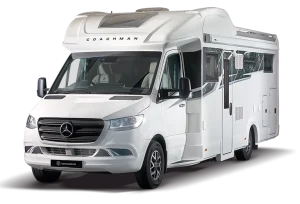
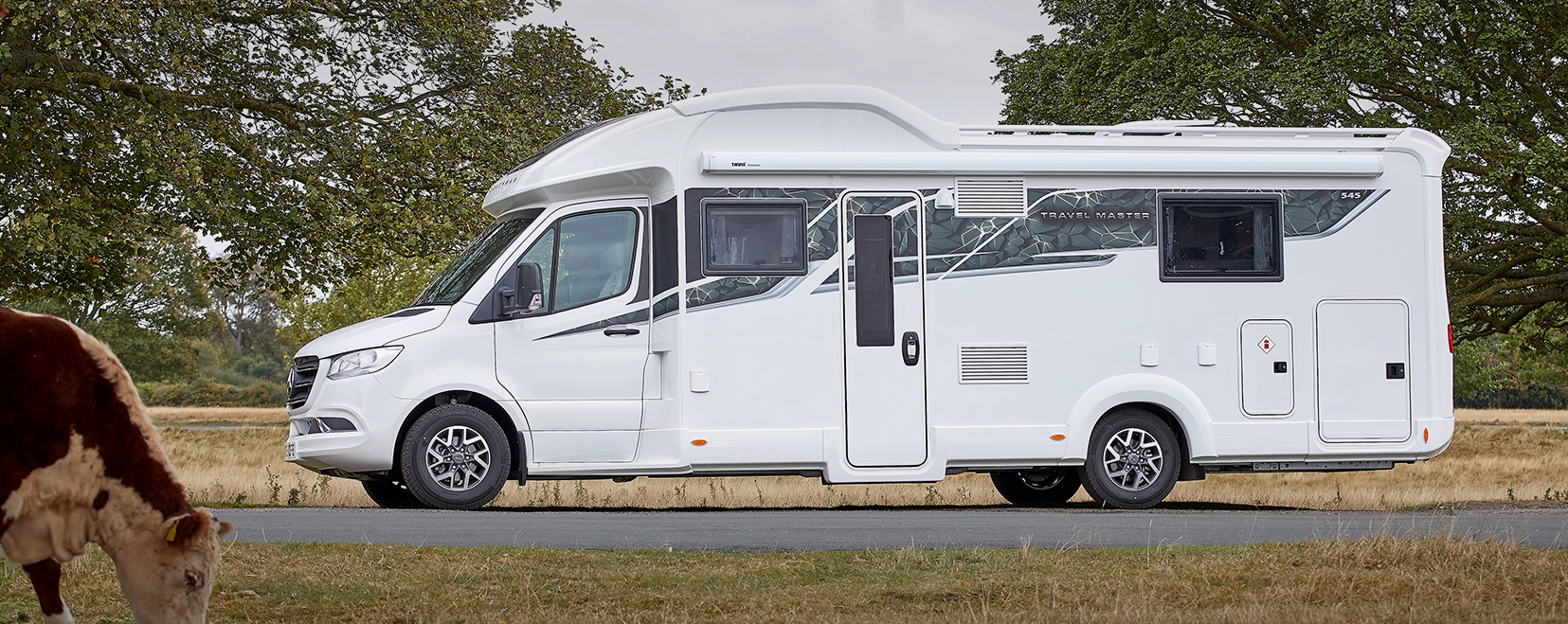
The Coachman Travel Master is designed for travellers prioritising generous living space and comfort on extended trips. Its two layouts provide either an island bed in the 545 or fixed single beds in the 565, alongside premium living and washing facilities on a Mercedes-Benz Sprinter base with AL-KO chassis.
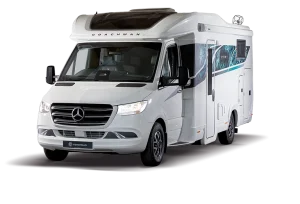
The Coachman Sportivo is a two-berth model suited to couples or solo travellers who want premium long-distance comfort in a more manageable 3,500kg motorhome. Its Mercedes-Benz Sprinter base, automatic transmission and practical rear storage make it particularly relevant to multi-stop touring.
Buyers comparing the two can also read Coachman’s Mercedes motorhome touring guide.
Frequently asked questions
Do British tourists need a visa to tour Europe in a motorhome?
British citizens can normally visit the Schengen area for tourism without a visa for up to 90 days in any rolling 180-day period. Longer stays or non-tourism activities may require a visa or permit.
Is ETIAS required for summer 2026?
No. As of July 2026, ETIAS is not operational and applications cannot currently be submitted. It is expected to launch during Q4 2026, though this date has slipped multiple times. Check official EU sources before travel, particularly if planning a late 2026 or 2027 trip.
Will there be delays at Dover because of EES this summer?
Yes, delays are likely. The automated EES processing facility at Dover is not currently operational, meaning manual checks are in place. Allow significant extra time at the port, follow current Dover travel advice on arrival times, and consider an alternative crossing route if your itinerary allows.
Do I need to register for EES before travelling?
No. EES registration takes place during the border process itself. On your first applicable journey, you may be asked to provide fingerprints and a facial image. There is no application form and no fee.
Can I use my UK driving licence in Europe?
A valid UK photocard licence can normally be used in the EU, Switzerland, Norway, Iceland and Liechtenstein without an IDP. Check that the licence includes the correct entitlement for your motorhome’s weight.
Can I sleep anywhere in my motorhome?
No. Wild camping and overnight-parking rules vary between countries, regions and municipalities. Use authorised campsites, aires and recognised stopovers, and always follow local signs.
Can I bring food back from the EU?
Restrictions currently apply to bringing many meat and dairy products from the EU into Great Britain. This can include items such as cheese, cured meats and sandwiches. Check the latest rules on the official UK government website before stocking the motorhome for the return crossing.
Plan carefully, but leave room for discovery
The most useful motorhome Europe travel tips combine preparation with flexibility. Organise your documents, understand the entry systems and research the driving rules before leaving — but avoid scheduling every hour of the holiday.
Allow time to stay an extra night when you discover somewhere special. Choose sensible daily distances, plan rest days and remember that the journey is part of the experience.
Explore the complete Coachman motorhome range or find your nearest Coachman dealer to compare the Travel Master, Sportivo and other models built for memorable journeys across the UK and Europe.