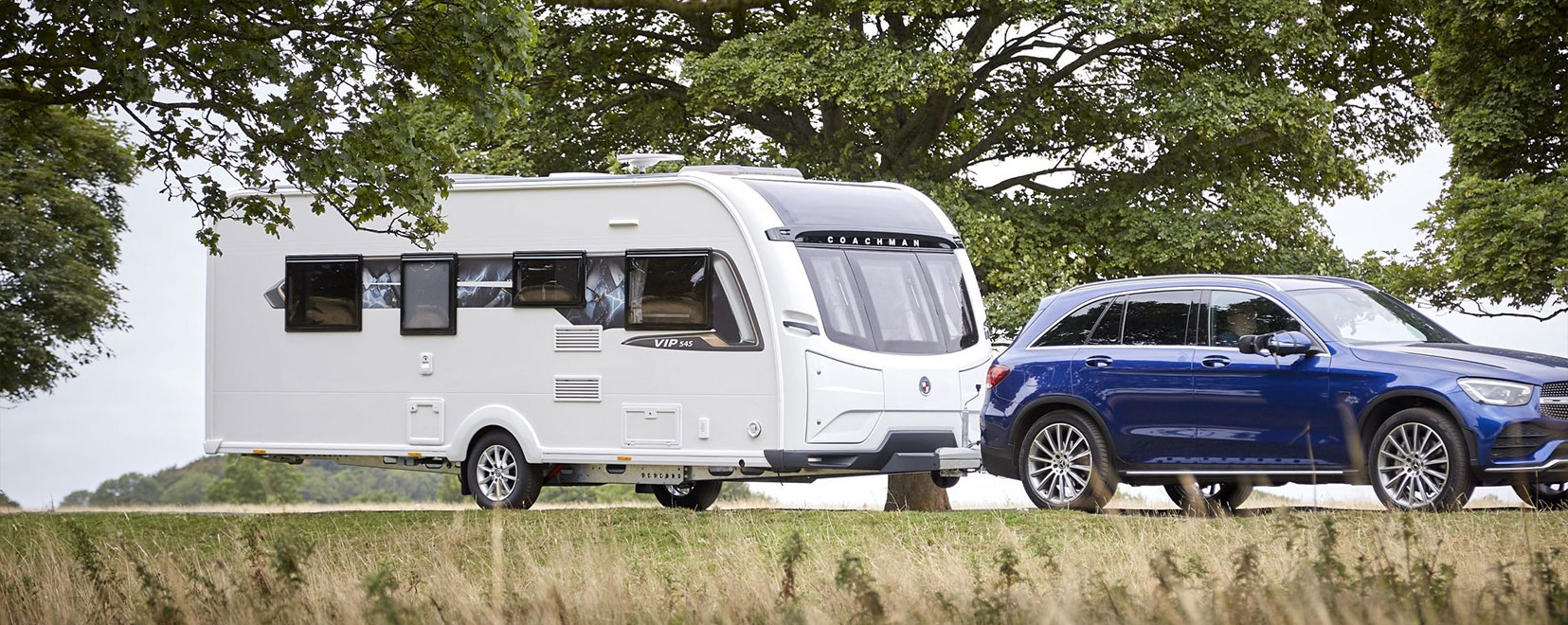
Whether you’re a first-time buyer or upgrading after years on the road, choosing the right touring caravan is one of the most important decisions you’ll make as a caravanner. With hundreds of models, layouts and features on the market, knowing where to start can feel overwhelming.
This guide covers everything you need to know – from understanding caravan types and key specifications, to finding the right layout for your lifestyle. And when you’re ready to explore the finest British-built tourers available, the Coachman caravan range is a natural place to start.
What Is a Touring Caravan?
A touring caravan is a wheeled leisure vehicle towed behind a car and used as mobile holiday accommodation. Unlike static caravans, which are permanently sited at holiday parks, touring caravans travel with you – to coastal campsites, rural retreats, countryside club sites and everything in between.
Touring caravans come in a huge range of sizes, from compact two-berth models ideal for couples, through to large twin-axle family vans that sleep five or more. Modern caravans are remarkably well-equipped, featuring full kitchens, washrooms, central heating, and comfortable living spaces that rival a hotel room.
Caravan or Motorhome? Understanding the Difference
The first choice many buyers face is whether they want a touring caravan or a motorhome. Here’s a quick comparison:
Touring caravan
- Requires a suitable towcar.
- Offers high flexibility on site because you can detach the caravan and explore freely by car.
- Generally has a lower purchase cost than a motorhome.
- Usually has lower running costs.
- Requires secure storage space at home or at a dedicated storage facility.
- Often depreciates more slowly than a motorhome.
Motorhome
- Self-propelled, with no towing required.
- Less flexible once pitched, because you need to drive the whole unit when leaving site.
- Generally has a higher purchase cost than a touring caravan.
- Usually has higher running costs, including fuel and insurance.
- Can be harder to store at home due to its size.
- Depreciation can be faster.
For many families and couples, a touring caravan offers the best of both worlds: the space and comfort of a home away from home, with the flexibility to detach and explore your destination in your car.
Key Things to Consider When Buying a Caravan
1. Berths and Layout
A caravan’s ‘berth’ refers to the number of people it can sleep. Common configurations include:
• Two-berth: Ideal for couples. Often features a fixed double or island bed, maximising living space.
• Four-berth: Suits couples or small families. May include a pull-out or drop-down bed in the lounge.
• Five-berth: Great for families with children. Typically a twin-axle with bunk beds or separate bedroom area.
Beyond berths, think carefully about the layout. Do you prefer a fixed bed you don’t have to make up each night? An island bed (freestanding, accessible from both sides)? An end washroom for privacy? Or a rear kitchen for easy meal preparation?
2. Weight and Towing Compatibility
This is one of the most important and most overlooked aspects of caravan buying. Your caravan’s MTPLM (Maximum Technically Permissible Laden Mass) must be compatible with your towcar’s maximum towing capacity. As a general rule:
• The caravan’s MTPLM should be no more than 85% of your car’s kerbweight (the ‘85% rule’)
• Check your car’s V5C logbook or handbook for its maximum towing capacity
• Noseweight (the downward force the caravan exerts on the towball) typically should not exceed 100kg and should be within your car’s stated limit
Exceeding these limits is not just dangerous – it can invalidate your insurance. Use the NCC’s online tow match tool, or speak to your Coachman dealer, to find a suitable match.
3. Single Axle vs Twin Axle
Single-axle caravans (one set of wheels on each side) are lighter, easier to manoeuvre and generally less expensive. Twin-axle caravans (two sets of wheels) offer greater stability and typically more interior space, making them popular with families or those planning longer trips.
4. Construction and Build Quality
Not all caravans are built to the same standard. Look for models constructed with:
• GRP (Glass Reinforced Plastic) or composite panels – more durable and better insulated than timber-framed alternatives
• Aluminium-framed or Alu-Tech construction for long-term structural integrity
• Quality double-glazed windows and well-sealed joints to prevent water ingress
All Coachman caravans are NCC (National Caravan Council) approved and come with a 10-year water ingress warranty, offering genuine peace of mind on build quality.
5. Heating and Insulation
If you plan to tour year-round – or simply want a cosy van – pay close attention to the heating system and insulation rating. Coachman’s VIP and Laser ranges feature Alde wet central heating as standard: a hydronic system that heats the van gently and evenly, including the floor, rather than relying on blown air.
Most modern caravans also carry an insulation rating, typically a 3-season or all-season grade, indicating how well they retain heat in cooler weather.
6. Spec and Features
Think about what you’ll actually use on tour. Key features to consider include:
• Kitchen: hob type (gas, dual-fuel), oven size, fridge capacity (compressor vs absorption)
• Washroom: separate shower vs combined shower/toilet, shower cabinet vs cubicle
• Connectivity: USB/12V charging points, solar panel, TV aerial
• Storage: overhead lockers, under-seat storage, dedicated wardrobe space
• Safety: Al-Ko hitch lock compatibility, ATC (Automatic Trailer Control) stability system
The Coachman Caravan Range
Coachman has been building premium touring caravans in East Yorkshire since 1986. Every caravan in the 2026 range is designed and manufactured in Britain, combining handcrafted build quality with contemporary interiors and genuine innovation.
The current range spans four model lines, each targeting a different level of the market:
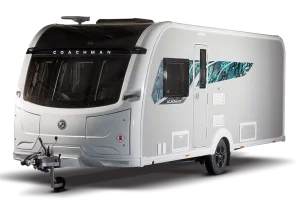
Coachman Acadia – From £30,340
The entry point to the Coachman range, and no compromise in quality. The 2026 Acadia has been revamped with updated upholstery, a redesigned kitchen, and new exterior graphics. Available in four layouts from compact two-berth to five-berth family twin axle, the Acadia is ideal for couples and families seeking premium quality at a more accessible price point.
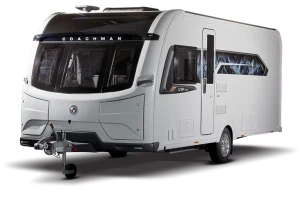
Coachman VIP – From £34,470
Coachman’s best-selling range, and for good reason. The VIP delivers signature comfort and practicality in five layouts, all single axle. Highlights include Alde wet central heating, a premium dual-fuel kitchen, and domestic-style fixtures throughout. New for 2026: the VIP 545 – a brand-new layout with end island bed and central washroom. A new high-security entrance door is fitted across the range.
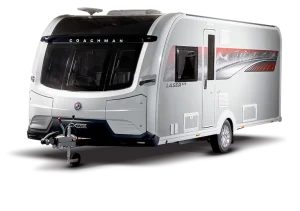
Coachman Laser – From £37,990
The Laser sits at the top end of the Coachman range, offering seven 8ft-wide Xtra layouts — including the brand-new 480 Xtra, the UK’s first 8ft-wide two-berth. The Laser’s wider bodyshell creates a genuinely spacious interior, while premium finishes and a comprehensive specification make it one of the finest tourers on the UK market. Available in both single and twin-axle configurations.
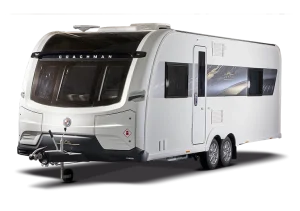
Coachman Lusso – From £49,100
The flagship Coachman range, representing the very best of British caravanning. The Lusso features solar panels and Truma Comfort Air Conditioning as standard — a genuine first for a production British caravan. With four layouts and an interior that genuinely feels like an apartment on wheels, the Lusso is for buyers who want the absolute best.
What to Look for at a Caravan Show or Dealer
Before you buy, always view caravans in person. When visiting a dealer or show, look for:
• Stand in the living area with your partner – does it feel spacious enough?
• Open every locker and drawer – is the storage practical for your needs?
• Check the bed size and access – can you get in and out comfortably?
• Inspect the washroom – is the shower large enough? Is there adequate storage for toiletries?
• Ask about the heating system – is it Alde or blown air?
• Check the MTPLM against your car’s towing capacity before falling in love with a model
Coachman’s network of approved dealers across the UK can demonstrate the full range and help match you to the right model.
Find your nearest Coachman dealer
New or Used?
Buying new gives you the latest specification, full manufacturer warranty, and the knowledge that the van has never been used or potentially neglected. The 10-year water ingress warranty on all new Coachman models offers significant additional peace of mind.
Buying used can offer considerable savings, but always commission an independent damp check before purchase, check the service history, and ensure the van comes with documentation confirming it is free of outstanding finance.
Frequently Asked Questions
What is the best touring caravan for a first-time buyer?
For first-time buyers, a single-axle model with a straightforward layout tends to be easiest to manage. The Coachman Acadia and VIP ranges are both excellent choices, offering premium build quality with practical, easy-to-tow dimensions. Speak to a Coachman dealer about matching the right model to your towcar.
How much does a new touring caravan cost in the UK?
New touring caravans typically range from around £15,000 for an entry-level model up to £50,000+ for a flagship luxury van. The Coachman range starts from £30,340 for the Acadia and extends to £49,100+ for the Lusso.
Can I tow a caravan with any car?
No – your car must have a sufficient towing capacity and the right towbar fitted. The standard guidance is that the caravan’s MTPLM should not exceed 85% of the car’s kerbweight. Always check your car’s handbook and the caravan’s MTPLM before purchasing.
What does NCC approved mean?
NCC (National Caravan Council) approval is a quality mark awarded to caravans that meet independently verified standards of construction, safety and environmental performance. All Coachman caravans are NCC approved.
How long does a touring caravan last?
A well-maintained touring caravan can last 20 years or more. Protecting against water ingress, the primary cause of caravan deterioration, is key. Coachman’s 10-year water ingress warranty reflects the brand’s confidence in its construction.